Damascus steel: what it is and where its pattern comes from
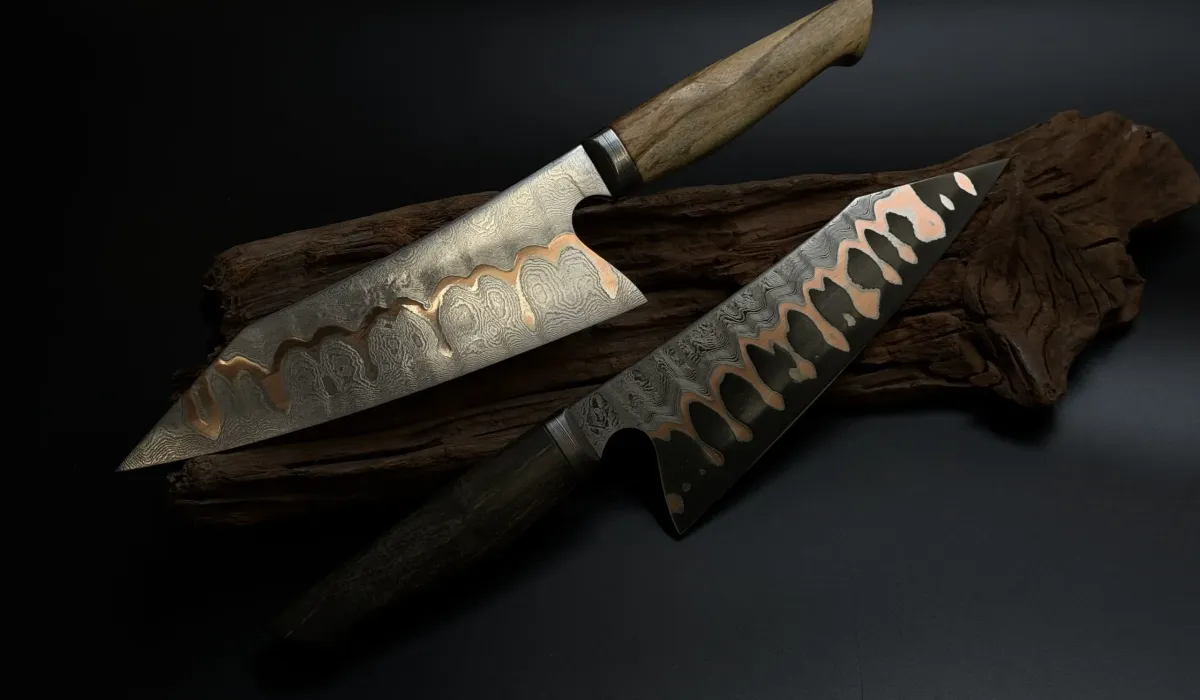
The pattern on a Damascus blade is not engraved or printed. It is a trace of how the steel was forged – every wave is the border between two kinds of steel. Here is how such steel is made and what to keep in mind with a Damascus knife.
What Damascus steel is
Damascus steel is made of layers of at least two different steels. The smith stacks them, heats them in the forge and joins them under a hammer or a press by forge welding. At a high temperature the layers bond into one piece – with no glue and no welds. The result is a billet, which is then forged and ground into a blade.
The name recalls the famous blades from Damascus in Syria. Those were made differently, from so-called wootz steel, and their exact method has been lost. Today's Damascus is welded from layers and follows the European and Japanese tradition of layered blades.
Where the pattern comes from
Polished Damascus looks like plain steel – the layers cannot be seen. The pattern only appears after etching in acid. Each steel reacts differently: steel with more carbon turns dark, steel with nickel stays bright. That is how the dark and light lines show up on the blade.
The smith decides the shape of the pattern. The billet can be folded, twisted, cut or pressed into shapes. The same steels can give a fine pattern that looks like wood grain, bold waves or geometric figures. That is why every Damascus blade is unique – not even two knives from one billet have the same pattern.
What the number of layers means
For our knives we give the number of layers of the Damascus – for example 50, 100, 200 or 400. The number grows by folding again and again: the billet is cut, the pieces are stacked and welded again, so the layers multiply. More layers give a finer, denser pattern; fewer layers give bolder, wider lines.
The number of layers on its own has little effect on how the knife cuts. What matters is the choice of steels and above all their heat treatment – hardening and tempering.
San-mai, CuMai and a core of another steel
Not every blade is Damascus all the way through. In a San-mai blade (Japanese for “three layers”) a hard core in the middle forms the edge, and further layers protect it on both sides – often Damascus ones. The edge stays sharp for a long time and the blade is tough at the same time.
In CuMai Damascus, layers of copper sit between the layers of steel and draw warm copper lines on the blade. CuNiMai adds nickel as well. Such blades have a core of tool steel – for example the Traditional Tanto, the Batik ManGOO Bowie and the Yin Yang set have a K720 core.
Damascus and rust
Most Damascus steels – our carbon Damascus too – are not stainless. That is why they harden well and take a very sharp edge, but without care they can rust. A few simple habits are enough:
- rinse the knife after use, dry it straight away and do not leave it in the sink,
- do not put it in the dishwasher,
- now and then wipe the blade with a thin layer of oil – kitchen knives with mineral oil, others for example with traditional choji oil,
- do not put a damp knife into its sheath.
Over time the blade takes on a darker patina that protects it and makes the pattern stand out even more. A detailed guide is on the Knife care page.
Forge your own Damascus
If you want to try the whole process yourself, on the Damascus Steel Course in our Bratislava workshop you forge your own Damascus billet in two days. On the Damascus Knife Course you make a finished knife from Damascus – from grinding and etching to the sheath. Finished Damascus knives are in our shop.