How to choose a kitchen knife: chef’s knife, bunka or a small knife
A kitchen does not need a set of ten knives. One good knife that fits your hand does most of the work, perhaps with one smaller knife next to it. How do you choose the right one?
The chef’s knife – an all-rounder
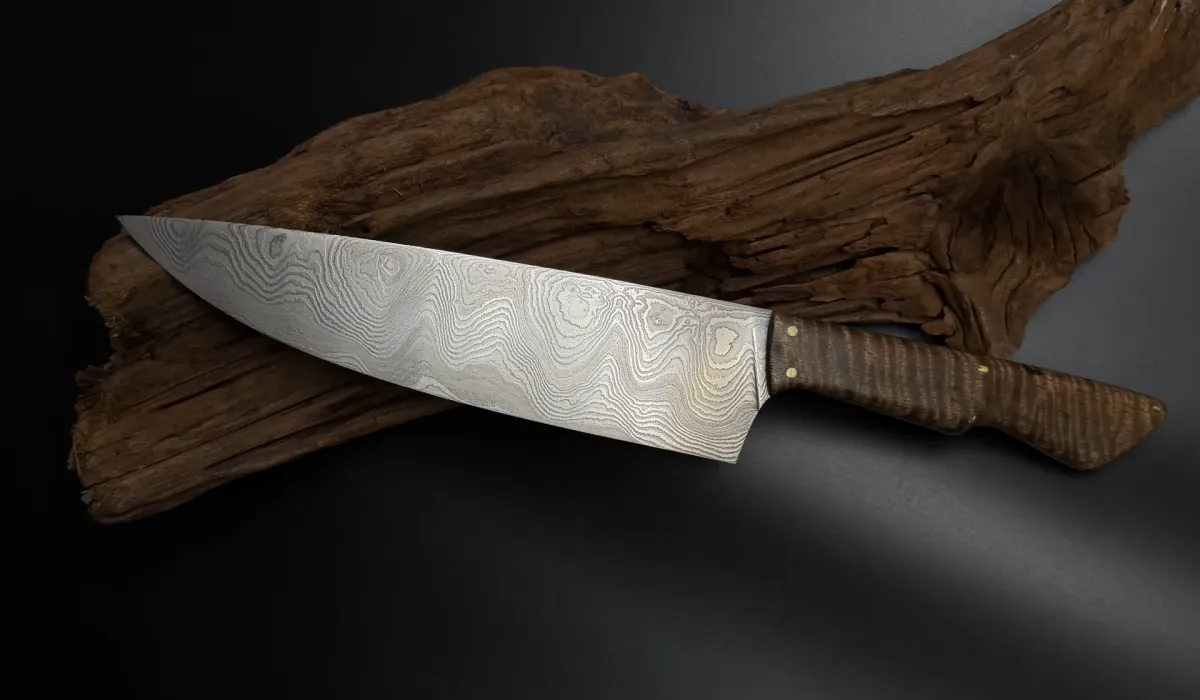
A chef’s knife usually has a blade of 18 to 24 cm with a slightly curved edge. The curve lets you cut with a rocking motion – the tip stays on the board while the back of the blade rises and falls. It is good for vegetables, meat, herbs and garlic. If you are going to have just one knife, this is it. Our ManGOO Chef has a 19 cm blade – long enough for large vegetables and still easy to control.
The bunka – a Japanese all-purpose knife
The bunka is a Japanese shape with a straighter edge and an angled tip. You cut with it forward and down rather than rocking. The straight edge touches the board along its whole length, which makes the bunka excellent for thin slices and precise cutting of vegetables. The sharp tip is handy for fine work, for example with onions. The MapleBURL Bunka has a 17 cm blade.
A small knife – for the small jobs
A good second knife is a small one with a blade of about 8 to 10 cm. It is for peeling, cutting fruit and everything where a big knife is simply too big.
What to look for
- How it feels in the hand. The handle should be comfortable for your hand and the knife balanced – it should not tip forward or back. If you can, hold the knife before you buy it.
- Blade length. A shorter blade is easier to control, a longer one handles bigger pieces. For most homes 17 to 21 cm is ideal.
- Steel. Carbon and Damascus steel take a very sharp edge and keep it for long, but they need drying and an occasional coat of oil. Stainless steel needs less care. More about Damascus in Damascus steel: what it is and where its pattern comes from.
- Handle. Stabilised wood, for example mango or maple burl, is wood filled with resin. It looks beautiful and copes with water better than ordinary wood.
How to care for a kitchen knife
A good knife lasts a lifetime if you treat it right:
- cut on a wooden or plastic board, not on glass or stone,
- do not wash the knife in the dishwasher, dry it straight after washing,
- store it so that the edge does not touch other things – on a magnetic strip or in a block,
- now and then wipe a carbon or Damascus knife with a thin layer of mineral oil, which is suitable for knives that touch food.
More on the Knife care page.
A knife made for you
If none of the ready-made shapes suits you, we will make you a custom knife – with the blade length, shape and handle you want. And if you would like to make your own knife, come to a knife-making course in our Bratislava workshop. Finished kitchen knives are in the shop.